
Migrating from SAS to Python is one of the most significant modernization initiatives a data-driven organization can undertake. While the benefits are compelling -- reduced licensing costs, access to a broader talent pool, and integration with modern cloud platforms -- the journey is rarely straightforward. Organizations with decades of SAS code face real technical, organizational, and regulatory challenges.
In this article, we break down the ten most common challenges of SAS-to-Python migration and provide actionable strategies for overcoming each one.
1. Data Step Logic Complexity
The SAS DATA step is unique in the programming world. It combines data reading, transformation, conditional processing, and output in a single implicit loop construct. Features like the Program Data Vector (PDV), automatic variable retention, and implicit looping have no direct equivalent in Python.
The challenge: SAS developers often write data step code that depends on subtle behaviors such as automatic variable initialization at the top of each iteration, the RETAIN statement, first.variable and last.variable processing, and output statements that control which rows are written.
How to overcome it: Map DATA step patterns to pandas idioms systematically. The groupby().transform() and groupby().apply() methods handle first/last processing. The assign() method chains transformations cleanly. For complex multi-output DATA steps, break them into discrete pandas operations. Automated translation tools can parse DATA step logic into an abstract syntax tree and generate equivalent pandas code that preserves the original behavior.

SAS to Python migration — automated end-to-end by MigryX
2. Macro Translation
SAS macros are a text-substitution system that generates SAS code dynamically. Large enterprises often have thousands of macros, many interdependent, that encode business logic, parameterize reports, and automate repetitive tasks. The macro language operates at a fundamentally different level than Python functions.
The challenge: SAS macros can generate arbitrary SAS code, including other macros. They use macro variables (&var), macro functions (%sysfunc), and conditional compilation (%if). Python has no direct equivalent to this text-generation paradigm.
How to overcome it: Convert macros to Python functions and classes. Simple parameterized macros map to Python functions with keyword arguments. Complex code-generating macros can be refactored into Python functions that return DataFrames or use string templates for dynamic SQL generation. The key is to first catalog all macros, identify their dependencies, and classify them by complexity before beginning conversion.
MigryX: Purpose-Built for Enterprise SAS Migration
MigryX was designed from the ground up for enterprise SAS migration. Its SAS parser understands every construct — DATA steps, PROC SQL, PROC SORT, PROC MEANS, PROC FREQ, PROC TRANSPOSE, macros, formats, informats, hash objects, arrays, ODS output, and even SAS/STAT procedures like PROC REG and PROC LOGISTIC. This is not a generic code translator — it is the most comprehensive SAS migration platform in the industry.
3. Format and Informat Mapping
SAS formats and informats control how data is read, displayed, and stored. Custom formats created with PROC FORMAT are used extensively for data validation, categorization, and reporting. Many organizations have hundreds of custom formats embedded throughout their codebase.
The challenge: Python does not have a native concept of display formats attached to data columns. Custom SAS formats that map value ranges to labels (like mapping age ranges to categories) are essentially lookup tables embedded in the SAS catalog.
How to overcome it: Convert SAS formats to Python dictionaries or pandas Categorical types. Date and numeric formats map to Python's strftime and string formatting. Custom formats built with PROC FORMAT should be extracted into reusable Python mapping functions or lookup DataFrames. This ensures the business logic encoded in formats is preserved and testable.
4. Statistical Procedure Parity
SAS is renowned for its comprehensive library of statistical procedures. Procedures like PROC MIXED, PROC PHREG, PROC SURVEYLOGISTIC, and PROC GLIMMIX have been refined over decades and are trusted by statisticians worldwide.
The challenge: While Python's statsmodels and scikit-learn cover most common statistical methods, some specialized SAS procedures produce output that does not have an exact one-to-one match in Python. The output format, test statistics, and even default options can differ.
How to overcome it: Map SAS procedures to their closest Python equivalents. PROC REG maps to statsmodels.OLS. PROC LOGISTIC maps to statsmodels.Logit or sklearn.LogisticRegression. For specialized procedures, the lifelines package handles survival analysis, linearmodels covers panel data, and scipy.stats provides a wide range of statistical tests. Validate results by running both SAS and Python code on the same data and comparing outputs to within acceptable tolerances.
5. Performance at Scale
SAS handles large datasets efficiently through its native file format and in-database processing capabilities. Organizations processing terabytes of data daily need assurance that Python can match or exceed SAS performance.
The challenge: Naive pandas code on large datasets can be slow and memory-intensive. A single pandas DataFrame must fit in memory, which is a limitation for very large datasets.
How to overcome it: Leverage PySpark or Dask for distributed processing of large datasets. Use chunked reading with pd.read_csv(chunksize=...) for files that exceed memory. Push computation into the database using SQLAlchemy or Snowpark for Python. Modern cloud platforms provide virtually unlimited compute, making Python-based processing at scale not just possible but often faster than SAS.
Performance Tip
For datasets under 10 GB, optimized pandas with proper dtypes is typically sufficient. For 10-100 GB, consider Polars or Dask. For 100 GB and above, PySpark on Databricks or Snowpark provides the distributed computing power needed.
6. Team Retraining
Many SAS teams have spent years or even decades building expertise in SAS programming. Asking them to learn Python is a significant organizational change that affects morale, productivity, and delivery timelines.
The challenge: SAS programmers think in DATA steps and PROC calls. Python requires a different mental model centered on objects, methods, and library APIs. The learning curve is real, especially for team members who have only ever used SAS.
How to overcome it: Invest in structured training programs that bridge SAS concepts to Python equivalents. Pair experienced Python developers with SAS experts. Create a SAS-to-Python reference guide specific to your organization's common patterns. Start migration with simpler programs to build confidence before tackling complex codebases. Many organizations find that their SAS team members become productive in Python within three to six months with proper support.
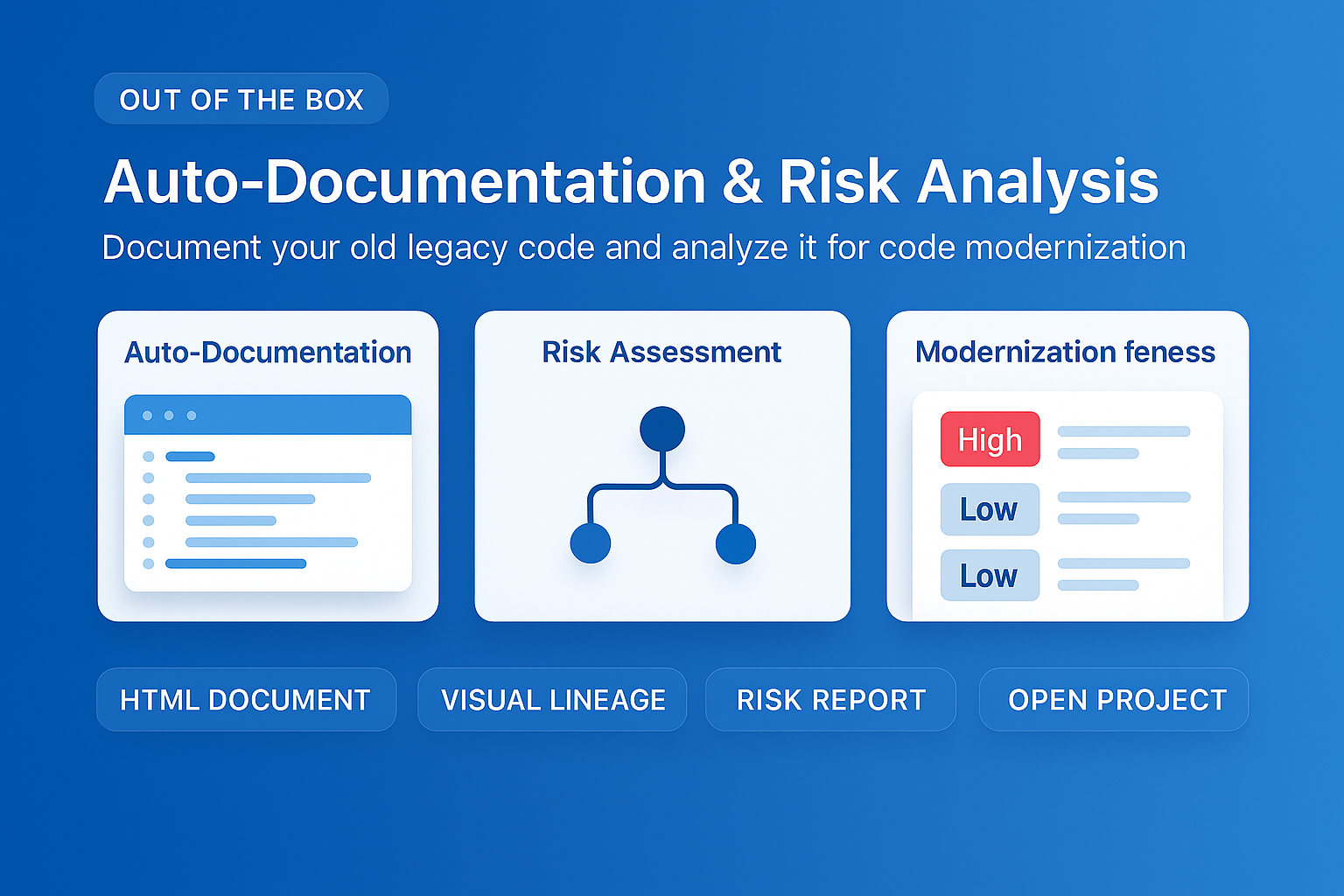
MigryX auto-documentation captures every transformation decision, creating audit-ready migration records automatically
How MigryX Handles the Hard Parts of SAS Migration
Every SAS shop has code that makes migration teams nervous — deeply nested macros that generate dynamic code, DATA step merge logic with complex BY-group processing, hash object lookups, RETAIN statements that carry state across rows, and PROC IML matrix operations. These are exactly the constructs where MigryX excels. Its combination of deterministic AST parsing and Merlin AI means even the most complex SAS patterns are converted accurately.
7. Regulatory Compliance
Industries like banking (Basel regulations, SR 11-7), pharmaceuticals (FDA 21 CFR Part 11), and insurance (Solvency II) have strict requirements around model validation, auditability, and reproducibility. SAS has a long track record in these regulated environments.
The challenge: Regulators need assurance that migrated code produces identical results. Audit trails must be maintained. In some cases, specific SAS outputs are referenced in regulatory filings.
How to overcome it: Build a comprehensive validation framework that compares SAS and Python outputs at every stage. Document the migration process thoroughly, including mapping decisions and any intentional deviations. Use version control (Git) for all Python code, which actually provides better auditability than traditional SAS program libraries. Engage your compliance team early and treat migration validation as a formal testing exercise with sign-off requirements.
8. Testing and Validation
Ensuring that migrated Python code produces the same results as the original SAS code is the single most critical aspect of any migration project. A single numerical discrepancy can undermine confidence in the entire effort.
The challenge: SAS and Python may handle edge cases differently -- floating-point precision, missing value treatment, date calculations, and sort stability can all produce subtle differences.
How to overcome it: Implement automated regression testing that runs SAS and Python code on identical input data and compares outputs row by row and column by column. Define acceptable tolerance thresholds for numerical comparisons. Test with production-scale data, not just small samples. Track discrepancies systematically and resolve them before moving to production. Automated migration platforms can generate validation reports as part of the conversion process.
9. Data Connectivity
SAS provides native connectors to virtually every enterprise database and file format through SAS/ACCESS modules. Organizations rely on these connections for daily data pipelines.
The challenge: Replicating every SAS/ACCESS connection in Python requires identifying and configuring the appropriate Python libraries and database drivers.
How to overcome it: Python's database connectivity ecosystem is mature and comprehensive. Use sqlalchemy for general database access, cx_Oracle for Oracle, pyodbc for SQL Server, snowflake-connector-python for Snowflake, and psycopg2 for PostgreSQL. For SAS-specific file formats, pandas.read_sas() reads SAS7BDAT and XPORT files natively. Map each SAS LIBNAME to its Python equivalent connection early in the project.
10. Change Management
Perhaps the most underestimated challenge is the human and organizational dimension of migration. Stakeholders need confidence that the new system works. Business users need assurance that their reports will still be accurate. IT teams need to support a new technology stack.
The challenge: Resistance to change is natural, especially when existing SAS systems are perceived as working fine. Without executive sponsorship and clear communication, migration projects can stall.
How to overcome it: Secure executive sponsorship with a clear business case focused on cost savings and talent availability. Communicate the migration roadmap transparently. Celebrate early wins by migrating visible, high-impact programs first. Create a center of excellence that provides ongoing support and best practices. Remember that migration is a marathon, not a sprint -- plan for 12 to 24 months for large codebases.
Successful SAS-to-Python migration is 30% technical and 70% organizational. The organizations that invest in people, process, and validation alongside technology are the ones that succeed.
Each of these challenges is solvable with the right approach, tools, and mindset. Automated migration platforms like MigryX address the technical challenges by parsing SAS code, generating equivalent Python, and providing validation frameworks that dramatically reduce risk and timeline. But technology alone is not enough -- pairing automation with strong project management and team investment is the formula for a successful migration.
Why Every SAS Migration Needs MigryX
The challenges described throughout this article are exactly what MigryX was built to solve. Here is how MigryX transforms this process:
- Complete SAS coverage: MigryX handles every SAS construct — DATA steps, PROC SQL, macros, formats, hash objects, arrays, ODS, and 20+ PROCs.
- 4-8x faster than manual: What takes consulting teams months of manual conversion, MigryX accomplishes in weeks with higher accuracy.
- 60-85% cost reduction: Enterprises report dramatic cost savings compared to manual migration approaches.
- Production-ready output: MigryX generates clean, idiomatic Python, PySpark, Snowpark, or SQL — not rough drafts that need extensive rework.
MigryX combines precision AST parsing with Merlin AI to deliver 99% accurate, production-ready migration — turning what used to be a multi-year manual effort into a streamlined, validated process. See it in action.
Ready to modernize your legacy code?
See how MigryX automates migration with precision, speed, and trust.
Schedule a Demo